
Content
- 1 The Direct Answer: Recycled Filament Can Match Virgin Tenacity at 4.5 cN/dtex
- 2 The Recycling Chain from Bottle to Filament Spool
- 3 Mechanical Properties Compared: Virgin Versus Recycled Filament
- 4 Spinning Process Stability on Industrial Equipment
- 5 Colour Consistency and Dyeing Behaviour
- 6 Feedstock Quality Grades and Their Output Range
- 7 The Bottom Line: Target 4.2 cN/dtex Tenacity with a 0.66 IV Flake
The Direct Answer: Recycled Filament Can Match Virgin Tenacity at 4.5 cN/dtex
Recycled polyester filament yarn produced from post-consumer PET bottles now consistently reaches a tenacity of 4.0 to 4.5 cN/dtex, a range identical to standard virgin polyester filament grades used in apparel and home textiles. The critical enabler is the melt filtration stage: a continuous polymer filter with a 15 to 20 micron absolute rating removes solid contaminants to below 0.02 mm per kilogram, preventing filament breakage during high-speed draw texturing. Once intrinsic viscosity is restored to 0.62 to 0.68 dl/g through solid-state polycondensation of washed flakes, the resulting filament processes identically to virgin on circular knitting and rapier weaving machines with no adjustment of machine settings.
Therefore, the practical starting point for any specification is not a compromise on strength but rather a tightened requirement on colour consistency and filament evenness, which remain the only remaining gap between recycled and virgin filament when high-quality feedstock is used.
The Recycling Chain from Bottle to Filament Spool
Post-consumer PET bottles are collected, sorted by colour, and ground into flakes. The flakes undergo a hot wash at 85 to 90 degrees Celsius with a 2% sodium hydroxide solution to remove labels and adhesives, followed by a final rinse and drying to below 50 ppm moisture. Clean flakes are then fed into a solid-state polycondensation reactor where, under vacuum and at 200 to 210 degrees Celsius, the intrinsic viscosity rises from the bottle-grade 0.72 dl/g up to a fibre-grade 0.66 dl/g after melting and degradation controls, yielding a stable melt.
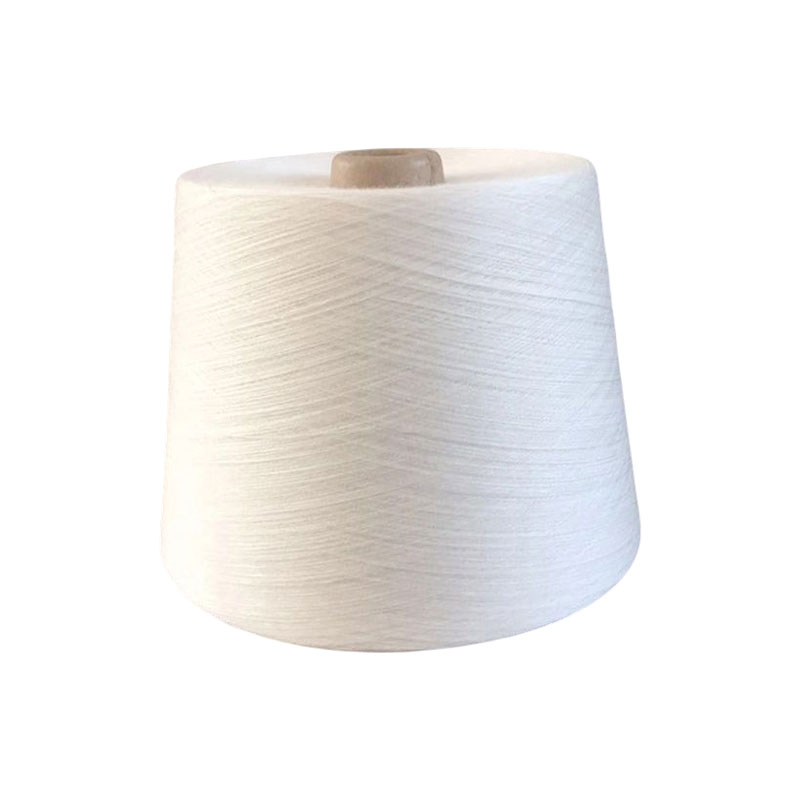
The melt passes through the 15-micron filter directly before the spinneret, where it is extruded through holes of 0.25 to 0.35 mm diameter. After quenching and spin finish application, the undrawn yarn is drawn and heat-set to achieve the target orientation and crystallinity. A 72-filament, 150-denier recycled polyester yarn drawn at a ratio of 2.8 to 3.2 will routinely produce fully drawn yarn with a breaking elongation of 25 to 35 percent and a 10% modulus of 2.5 to 3.0 cN/dtex.
Mechanical Properties Compared: Virgin Versus Recycled Filament
| Property | Virgin Polyester Filament | Recycled Polyester Filament |
|---|---|---|
| Tenacity (cN/dtex) | 4.2–4.8 | 4.0–4.5 |
| Elongation at break (%) | 28–35 | 26–33 |
| Boiling water shrinkage (%) | 5.0–7.0 | 5.5–7.5 |
| Uster evenness (CVm %) | 1.0–1.3 | 1.2–1.6 |
| Colour L* value deviation (dE) | 0.3–0.5 | 0.7–1.2 |
The data shows that recycled filament yields a slightly higher evenness variation, which translates to a minor decrease in fabric first-quality rate. With careful lot blending, a knitter can expect a first-quality rate of over 92 percent compared to 96 percent for virgin, a gap that is economically acceptable given the lower carbon footprint per kilogram.
Spinning Process Stability on Industrial Equipment
Recycled polymer melt has a wider molecular weight distribution than virgin, which broadens the draw resonance window. On a typical draw texturing machine running at 650 metres per minute, the optimum first heater temperature is reduced by 10 to 15 degrees Celsius relative to virgin yarn to prevent tight spots. The D/Y ratio should be set to 1.6 to 1.7 rather than 1.7 to 1.8 to keep broken filaments below 0.5 per kilogram.
For air-jet texturing of recycled polyester filament, the overfeed to the jet nozzle is slightly increased: 18 to 22 percent overfeed compared to 15 to 18 percent for virgin, compensating for the marginally lower melt strength of the recycled polymer. This adjustment produces loop stability equivalent to virgin textured yarns.
Colour Consistency and Dyeing Behaviour
The biggest technical hurdle in recycled polyester filament is the faint blue or green undertone from the original bottle plastics, measured as a b* value shift of minus 0.5 to minus 1.2 in the CIELab space compared to virgin polymer. This requires spectrophotometer-based sorting of bale lots before extrusion. Acceptable dEab variation from cone to cone should be held below 1.5 for piece-dyed fabrics destined for the same garment panel.
Disperse dye uptake, measured as the K/S value, is virtually identical to virgin polyester at the same dyeing temperature, with a variation of less than 2 percent across a lot. Dyeing at 130 degrees Celsius using standard levelling agents produces repeatable shade matching; however, a slight increase in oligomer content may require a double reduction clear step to prevent staining on finished goods.
Feedstock Quality Grades and Their Output Range
- Clear bottle flakes (Grade A): 98% transparency, suitable for semi-dull round filament, tenacity above 4.3 cN/dtex.
- Light blue bottle flakes (Grade B): Used for solution-dyed black filament or 50/50 blend with clear to produce heather effects.
- Post-industrial polyester waste: Yarn waste and fibre waste re-pelletized, producing filament with intrinsic viscosity above 0.60 dl/g, limited to coarse deniers above 300D.
The Bottom Line: Target 4.2 cN/dtex Tenacity with a 0.66 IV Flake
Recycled polyester filament is no longer a compromise material. By sourcing clean clear flake with a minimum intrinsic viscosity of 0.70 dl/g before extrusion and filtering melt through a 15-micron screen, filament producers can deliver yarns that weave and knit with the same efficiency as virgin. The recommended specification limit for full-strength textile-grade recycled filament is a tenacity of 4.2 cN/dtex minimum, an elongation of 28 percent minimum, and a Uster CVm no greater than 1.8%. Meeting these three numbers guarantees that the sustainable product does not force any downgrade in fabric performance, allowing brands to adopt recycled content without altering cut-and-sew operations.