
Content
Understanding Nylon Fiber Filament Yarn: Production, Types, and Performance
Nylon fiber filament yarn is a continuous-length synthetic yarn produced by melt-spinning polyamide polymer — most commonly Nylon 6 or Nylon 6,6 — into long, unbroken filaments that are drawn, textured, and wound into package form for downstream textile and industrial processing. Unlike staple fiber yarns, which are spun from short-length fibers, filament yarns consist of continuous strands running the full length of the package, giving the resulting fabric or structure a smooth, uniform surface, high tensile strength, and consistent cross-sectional properties throughout.
The filament count within a yarn — the number of individual continuous filaments twisted or bundled together — determines much of its tactile and performance character. Low-filament-count yarns (monofilament or low-denier multifilament) produce stiff, high-strength structures used in fishing lines, industrial filtration fabrics, and brush bristles. High-filament-count fine-denier yarns (microfilament, 100–300 filaments per yarn bundle) produce soft, drapeable fabrics used in hosiery, swimwear, lingerie, and sportswear. The same polymer chemistry — polyamide — serves both applications through variation in filament count, denier per filament (dpf), and post-spinning texturing treatments.
Flat (FDY) vs. Textured (DTY) Nylon Filament Yarn
Nylon filament yarns are commercially available in two primary structural forms that determine their end-use suitability:
- Fully drawn yarn (FDY): Produced in a single-step spin-draw process where the yarn is drawn to its final orientation immediately after extrusion. FDY nylon has high tenacity (typically 4.5–7.0 cN/dtex), low elongation, and a flat, smooth surface. It is the standard specification for warp-knit fabrics, industrial webbing, seatbelt fabric, parachute cloth, and technical textiles where strength and dimensional stability are primary requirements.
- Draw-textured yarn (DTY): Produced by false-twist texturing of partially oriented yarn (POY), which introduces a helical crimp into each individual filament. DTY nylon has lower tenacity than FDY but substantially higher bulk, stretch recovery, and softness — properties that make it preferred for hosiery, swimwear, athletic apparel, and circular-knit fabrics where stretch and comfort are design objectives.
Nylon 6 vs. Nylon 6,6 Filament Yarn
The two dominant polyamide chemistries used in filament yarn production have distinct property profiles that influence specification decisions:
- Nylon 6 (polycaprolactam): Melting point approximately 220°C, good dyeability with acid dyes, easier to recycle due to depolymerization back to caprolactam monomer. Dominant in European and Asian apparel and hosiery markets. More widely produced globally due to the single-monomer synthesis route.
- Nylon 6,6 (polyhexamethylene adipamide): Melting point approximately 255°C, higher heat resistance, marginally higher tenacity and abrasion resistance than Nylon 6 at equivalent denier. Preferred in North American automotive, industrial, and tire cord applications where heat stability is critical. Historically associated with premium hosiery and performance athletic apparel.
Key Filament Yarn Specifications for Buyers
Procurement teams sourcing nylon filament yarn for textile or industrial processing should evaluate and specify the following parameters to ensure material suitability and batch-to-batch consistency:
- Linear density (denier or dtex): Total yarn fineness expressed as mass in grams per 9,000 m (denier) or per 10,000 m (dtex). Apparel yarns typically range from 20D to 140D; industrial and technical yarns range from 210D to 1,890D and above.
- Filament count: The number of individual continuous filaments per yarn bundle, expressed as the second number in a denier/filament designation (e.g., 70D/34f = 70 denier, 34 filaments).
- Tenacity: Breaking strength normalized by linear density (cN/dtex or g/d). Standard textile grades: 4.0–5.5 cN/dtex; high-tenacity industrial grades: 7.0–9.5 cN/dtex.
- Elongation at break: Expressed as percentage. FDY nylon typically 20–35%; DTY nylon 25–45%; high-tenacity industrial yarn 15–25%.
- Finish oil content: Spin finish applied during production to manage friction and static during downstream processing. Typically 0.6–1.2% by weight; deviations cause processing problems on high-speed knitting and weaving equipment.
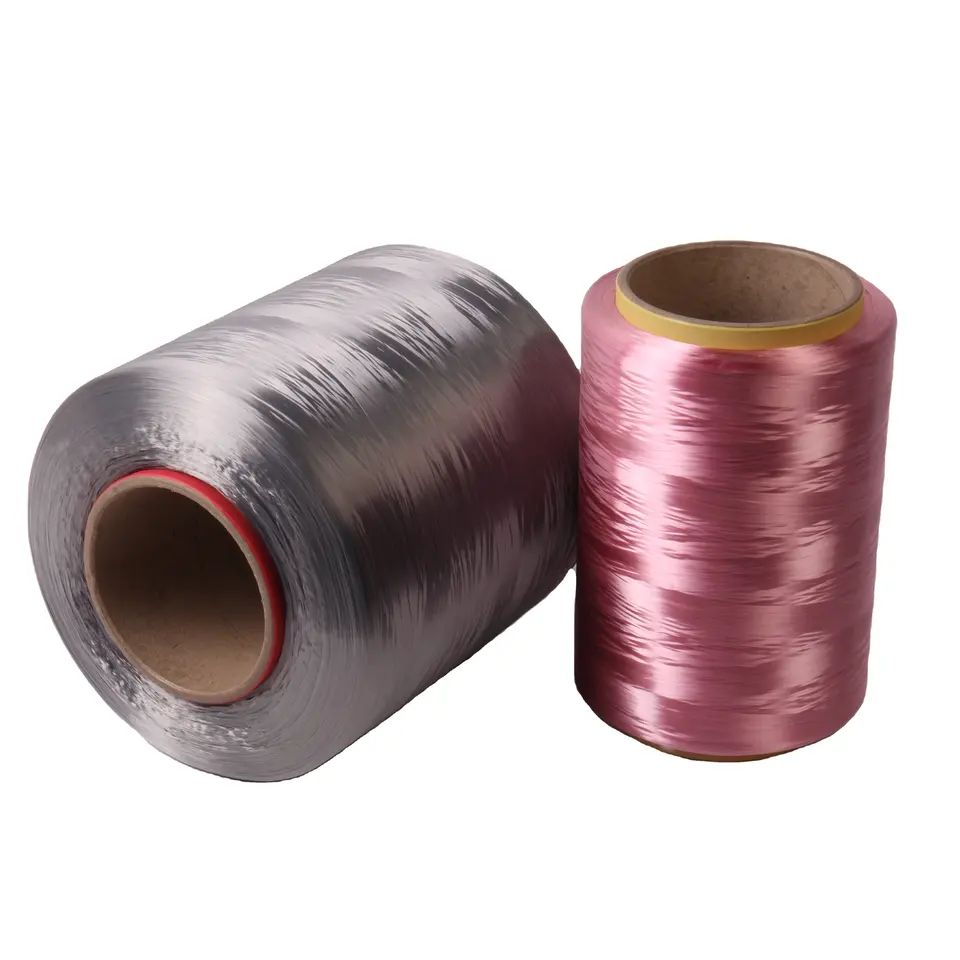
Nylon Fiber Filament Chips: The Upstream Raw Material
Nylon fiber filament chips — also referred to as polyamide chips, nylon granules, or nylon slices — are the solid polymer feedstock from which nylon filament yarn is produced. They are small cylindrical or pellet-form pieces of polyamide resin, typically 2–4 mm in diameter and 2–3 mm in length, produced by polymerization of the monomer(s), melt extrusion of the resulting polymer through a strand die, water quenching, and pelletizing. The chip form provides a stable, free-flowing material that can be transported, stored, dried, and fed consistently into melt-spinning extruders.
The quality of the nylon chips — specifically their molecular weight, molecular weight distribution, moisture content at spinning, and absence of contaminants — determines the spinability of the polymer and the ultimate physical properties of the yarn produced from it. Chip quality is therefore the foundational variable in the nylon filament yarn production chain, upstream of spinning conditions, draw ratios, and texturing parameters.
Critical Chip Quality Parameters
Yarn producers evaluating nylon chip suppliers assess the following technical parameters as primary quality indicators:
- Relative viscosity (RV) or formic acid viscosity: The most important single parameter for nylon chips destined for filament yarn production. RV reflects the average molecular chain length — a direct determinant of yarn tenacity, elongation, and processability. Standard fiber-grade Nylon 6 chips for textile filament spinning typically have an RV of 2.4–2.8 (measured at 1% concentration in 96% sulfuric acid); high-tenacity industrial yarn grades require RV of 3.0–3.5 or higher.
- Moisture content: Nylon chips are hygroscopic and must be dried to below 0.05–0.08% moisture immediately before melt spinning. Residual moisture above this threshold causes hydrolytic degradation of the polymer chains in the melt phase, reducing molecular weight, producing gel particles, and causing filament breaks during spinning. Chip dryers operating at 80°C–100°C under vacuum or dry air circulation for 8–16 hours are standard pre-spinning practice.
- Amino and carboxyl end group concentration: The balance of amine and carboxyl end groups on the polymer chains affects dyeability, thermal stability, and cross-linking behavior. Chips intended for deep-dyeing applications are formulated with elevated amine end group concentrations to increase acid dye uptake in the finished yarn.
- TiO₂ content (delusterant): Titanium dioxide particles are incorporated into nylon chips during polymerization to control yarn luster. Bright chips contain no TiO₂ and produce high-luster filament; semi-dull chips contain approximately 0.3–0.5% TiO₂ for standard apparel applications; full-dull chips contain 1.5–2.0% for matte-finish technical and industrial yarn.
- Extractables content (oligomers): Nylon 6 polymerization produces cyclic oligomers — primarily caprolactam monomer and its dimers and trimers — that are soluble in hot water and must be removed by hot-water extraction of the chips before spinning. Residual extractables above 0.5% cause filter pack pressure rise during spinning, reduced dye uptake, and surface blooming on finished fabric during wet processing.
| Parameter | Textile Filament Grade | Industrial / High-Tenacity Grade |
|---|---|---|
| Relative viscosity (RV) | 2.4–2.8 | 3.0–3.8 |
| Moisture content (pre-spin) | <0.08% | <0.05% |
| Extractables (oligomers) | <0.5% | <0.3% |
| TiO₂ content (semi-dull) | 0.30–0.50% | 0.10–0.30% or bright |
| Melting point (Nylon 6) | 218°C–222°C | 218°C–222°C |
| Primary end uses | Hosiery, swimwear, apparel, carpet | Tire cord, seatbelts, rope, filtration |
From Chips to Yarn: The Melt Spinning Process
The conversion of nylon chips into filament yarn follows a well-defined sequence of process steps, each of which must be tightly controlled to produce yarn within specification. Understanding this sequence clarifies why chip quality parameters translate directly into yarn quality outcomes.
Dried chips are gravity-fed or conveyed under inert atmosphere into a screw extruder, where they are melted at temperatures between 255°C and 285°C for Nylon 6, forming a homogeneous melt of consistent viscosity. The melt is pumped at precisely controlled pressure through a metering gear pump and into the spin pack — a filtered assembly containing a spinneret plate with multiple precisely drilled holes (typically 0.2–0.4 mm diameter) corresponding to the desired filament count of the yarn.
The fine melt streams extruded through the spinneret holes are quenched by a cross-flow or radial air stream in the spinning chimney, solidifying into individual filaments that are converged into a yarn bundle, coated with spin finish, and wound at speeds of 3,000–6,000 m/min for POY or passed directly through heated draw rolls for FDY production. The entire process from chip melt to wound package is continuous, operating under real-time monitoring of melt pressure, yarn tension, and package build to ensure batch consistency.
Any variation in chip RV, moisture, or oligomer content propagates directly into the spinning process as pressure fluctuations, filament break rate changes, or yarn physical property deviations — which is why chip quality specifications are enforced with tight tolerances by yarn producers operating high-speed spinning equipment where unplanned downtime and off-quality production carry significant cost consequences.