
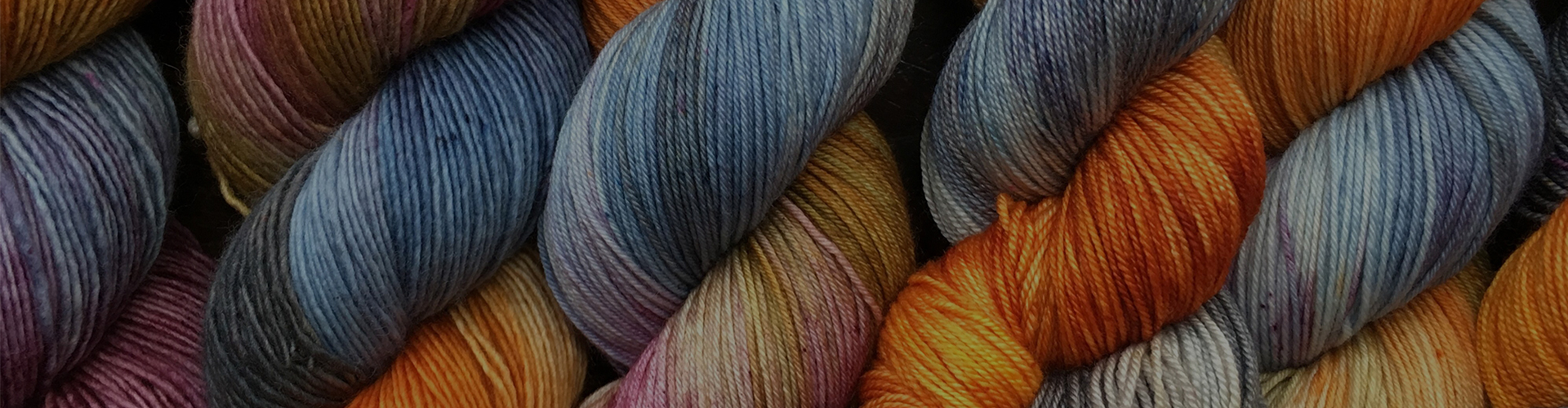
The most versatile polyester staple fiber for general textile spinning is a 1.4 denier, 38 mm solid fiber with a cut length matched to the cotton it will be blended with. This specification provides the optimal balance of spinnability, yarn evenness, and fabric hand. For nonwoven needle-punched felts, a 6 denier, 64 mm hollow conjugated polyester staple fiber delivers the required resilience and bulk, giving the finished geotextile a high loft that retains its thickness under a compressive load of 200 kilopascals.
Content
- 1 How Polyester Staple Fiber Is Made and Cut to Length
- 2 Denier and Its Impact on Finished Product Performance
- 3 Solid, Hollow, and Specialty Polyester Staple Fiber Types
- 4 Polyester Staple Fiber in Nonwoven Production
- 5 Blending Ratios and Their Effect on Yarn Quality
- 6 Testing Specifications That Verify Polyester Staple Fiber Quality
- 7 Storage and Handling Recommendations for Optimal Spinning Performance
How Polyester Staple Fiber Is Made and Cut to Length
Polyester staple fiber begins as continuous filament yarn extruded from polyethylene terephthalate polymer chips. The filaments are drawn to orient the polymer molecules, which develops the fiber's tensile strength, then crimped mechanically to give the fiber a wavy texture that grips neighboring fibers during spinning. The crimp frequency is typically 10 to 14 crimps per inch for textile-grade fiber, providing the cohesion necessary to form a uniform card web.
After crimping, the continuous tow is cut into predetermined lengths that match the staple length of the natural fibers with which the polyester will be blended. A polyester staple fiber for cotton blending is cut to 38 mm, while fiber for worsted wool blending is cut to 64 mm or longer. The cutting precision directly affects yarn quality. A variation of more than ±1 mm in cut length creates drafting irregularities that appear as thick and thin places in the spun yarn, reducing its breaking strength by up to 8 percent.
Denier and Its Impact on Finished Product Performance
The denier of a polyester staple fiber — the weight in grams of 9,000 meters of fiber — is the single most important specification to match to the intended end use. The table below maps denier ranges to their primary applications and the performance characteristic they optimize.
| Denier Range | Typical Cut Length | Primary Application | Key Performance Attribute |
|---|---|---|---|
| 0.8 to 1.2 | 32 to 38 mm | Fine count yarns, intimate apparel | Soft hand, excellent drape |
| 1.2 to 1.5 | 38 mm | Cotton blending, general textiles | Balanced strength and comfort |
| 3 to 6 | 51 to 64 mm | Nonwovens, carpet, filler | High resilience, bulk |
| 15 to 25 | 64 to 100 mm | Geotextiles, heavy felts | Structural stiffness, durability |
A polyester staple fiber of 1.4 denier is considered the workhorse of the spinning industry because it closely approximates the fineness of high-quality cotton. When blended at a ratio of 65 percent polyester to 35 percent cotton, the resulting yarn can be spun to counts as fine as Ne 40 with a yarn evenness CV of less than 12 percent on the Uster scale. Coarser fibers above 6 denier are never used for apparel yarns because they produce a harsh, scratchy hand that consumers reject.
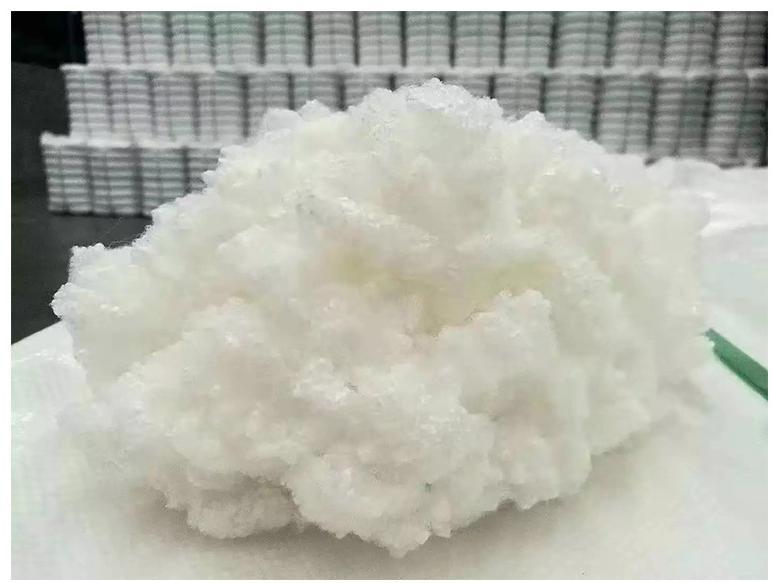
Solid, Hollow, and Specialty Polyester Staple Fiber Types
The cross-sectional shape of a polyester staple fiber determines its bulk, thermal insulation, and moisture transport properties. Three distinct categories serve different markets.
- Solid polyester staple fiber has a round cross-section and is used for standard spinning applications. It has a density of 1.38 grams per cubic centimeter, a tenacity of 4.5 to 5.5 grams per denier, and an elongation at break of 25 to 35 percent. Solid fiber is the default choice unless a specific functional requirement demands a modified cross-section.
- Hollow polyester staple fiber contains one or more continuous channels running the length of the filament. The hollow core reduces fiber density to approximately 1.0 to 1.2 grams per cubic centimeter and traps still air, increasing thermal insulation by 30 to 40 percent compared to solid fiber of the same denier. Hollow polyester staple fiber is the preferred filling for quilts, pillows, and winter outerwear.
- Low-melt polyester staple fiber has a modified copolymer composition that melts at 110 to 130 degrees C, significantly below the 260 degrees C melting point of standard polyester. When blended with regular fiber at 15 to 25 percent by weight and heated, the low-melt component flows and bonds the fibers together at their intersections, creating a self-reinforcing nonwoven without the need for latex or acrylic binders.
Polyester Staple Fiber in Nonwoven Production
The nonwoven industry consumes a significant portion of global polyester staple fiber production, using it to manufacture products that range from automotive headliners to filtration media. The fibers are opened, carded into a web, and then bonded through needle-punching, thermal calendering, or hydroentanglement. Fiber denier and finish play a decisive role in the web formation process.
For needle-punched geotextiles, a polyester staple fiber of 6 to 15 denier with a cut length of 64 to 90 mm provides the high tensile strength and puncture resistance required for soil stabilization and drainage applications. The fiber surface must be treated with an anti-static finish that dissipates the static charge generated during high-speed carding, which can otherwise reach 50,000 volts and cause the web to collapse. A properly finished fiber will process at speeds exceeding 150 meters per minute on a modern carding line without lap formation or fiber wrapping.
Blending Ratios and Their Effect on Yarn Quality
The proportion of polyester staple fiber in a blended yarn determines the balance between strength, comfort, and cost. A blend of 65 percent polyester to 35 percent cotton is the industry standard for workwear and uniform fabrics because the polyester provides strength and wrinkle resistance while the cotton provides absorbency and a natural hand. At this ratio, the yarn breaking strength is approximately 18 centinewtons per tex, which is sufficient to survive high-speed weaving without excessive warp breaks.
For garments that will be worn against the skin, a 50/50 polyester-cotton blend or an inverse blend of 35/65 polyester-cotton is preferred. The higher cotton content improves moisture absorption and reduces the synthetic feel of the fabric. However, reducing the polyester staple fiber content below 35 percent significantly decreases the yarn's abrasion resistance, making the fabric unsuitable for heavy-duty applications. A fabric with less than 35 percent polyester will lose over 20 percent of its weight after 1,000 Martindale abrasion cycles.
Testing Specifications That Verify Polyester Staple Fiber Quality
Before a shipment of polyester staple fiber is accepted into a spinning mill, it must pass a series of quality control tests that confirm it meets the agreed specifications. The most critical parameters and their acceptance criteria include:
- Denier variation: The average denier of the lot must not deviate more than ±3 percent from the nominal value, and the coefficient of variation within the lot must remain below 5 percent. Higher variation causes dye uptake differences that appear as shade bands in the finished fabric.
- Cut length accuracy: The average cut length must fall within ±1.5 mm of the specified length. Over-length fibers create drafting problems during spinning, while short fibers increase the yarn hairiness index.
- Crimp stability: The crimp retention after 10 minutes of tensioning at 0.1 grams per denier must exceed 70 percent. Fibers that lose their crimp permanently under tension produce a flat, lifeless yarn with poor cover.
- Finish level: The spin finish applied to the fiber surface should be between 0.08 and 0.15 percent by weight. Insufficient finish causes static buildup during carding, while excessive finish gums up the card clothing and drafting rollers.
Storage and Handling Recommendations for Optimal Spinning Performance
The condition of polyester staple fiber bales at the time of opening directly influences spinning efficiency. The bales must be stored in a conditioned area at 20 to 25 degrees C and 55 to 65 percent relative humidity for at least 24 hours before opening. Cold fiber brought directly from an unheated warehouse will condense moisture when exposed to warm spinning room air, causing the fibers to stick together and form nep clusters that survive carding and appear as defects in the yarn.
When laying down a bale mix for a long production run, bales from different production lots should be distributed evenly across the laydown to average out any small variations in denier or color. A well-managed laydown of polyester staple fiber will produce a consistent yarn lot after lot, keeping the fabric shade variation within a CMC color difference of 0.5 units, which is undetectable to the untrained eye.