
Content
What Is Recycled Polyester Filament and How It Is Produced
Recycled polyester filament (rPET filament) is a continuous-length synthetic yarn produced from post-consumer or post-industrial polyester waste — most commonly PET (polyethylene terephthalate) plastic bottles — rather than virgin petrochemical feedstock. The filament is chemically and physically indistinguishable from virgin polyester filament in most performance parameters while delivering a substantially reduced environmental footprint, making it one of the most commercially significant sustainable textile materials in production today.
The production process begins with collection and sorting of PET waste. Post-consumer PET bottles are the dominant feedstock globally — a single standard 500 ml PET bottle yields approximately 27 grams of recycled fiber, meaning a standard 200-gram fabric panel requires the equivalent of roughly seven to eight bottles. After sorting by color and polymer type, the bottles are cleaned, shredded into flake, and processed through one of two recycling pathways:
- Mechanical recycling (physical recycling) — the most widely used method. PET flake is melted, filtered to remove contaminants, and extruded through a spinneret to produce filament. The polymer chains are not chemically broken down; the material retains the same molecular structure as the input PET, though viscosity (molecular weight) decreases slightly with each recycling pass due to chain scission during remelting. Mechanical recycling is lower cost and higher volume than chemical recycling but has limits on the number of times a given material can be recycled before quality degradation becomes unacceptable.
- Chemical recycling (depolymerization) — the PET polymer is broken down to its monomer building blocks (most commonly BHET or DMT and EG, depending on the process) and re-polymerized into virgin-equivalent PET resin before spinning. Chemical recycling produces a higher-purity output that is genuinely equivalent to virgin PET in all performance dimensions, can accept mixed-color and more contaminated feedstock, and can theoretically recycle PET indefinitely without degradation. Commercial scale chemical recycling remains more expensive than mechanical recycling and currently represents a smaller fraction of total rPET production.
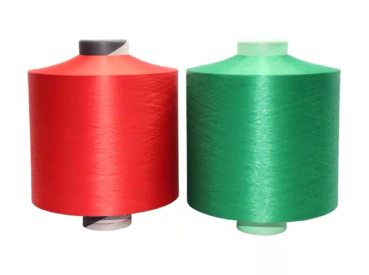
After extrusion, the filament is drawn (stretched) to orient the polymer chains along the fiber axis, which increases tensile strength and reduces elongation. The finished filament is wound onto cones or bobbins for direct use in weaving, knitting, or nonwoven production, or texturized — mechanically crimped or air-jet processed to add bulk and reduce the flat, slippery hand of untexturized filament.
Filament Types and Yarn Specifications
Recycled polyester filament is available in the same range of constructions as virgin polyester filament. Understanding the key specification dimensions is necessary for matching the material to the end application and for evaluating supplier offerings on a like-for-like basis.
Filament Count and Denier
Yarn linear density is expressed in denier (grams per 9,000 meters) or dtex (grams per 10,000 meters). Fine filaments for apparel and intimate wear range from 30D to 150D; medium deniers from 150D to 300D cover most woven and knitted fabric applications; heavy deniers above 300D are used in technical textiles, geotextiles, and industrial applications. Within any denier, the number of individual filaments in the yarn bundle determines filament fineness — a 150D/48f yarn has 48 individual filaments each at 3.1 dpf (denier per filament), producing a softer, more drapeable hand than a 150D/36f yarn with coarser 4.2 dpf filaments.
Flat vs. Texturized Filament
Flat (fully drawn yarn, FDY) is smooth, continuous filament with minimal crimp. It produces fabrics with a smooth, lustrous surface and is the standard for woven taffetas, linings, and technical fabrics where a clean surface appearance and dimensional stability are required. Flat rPET filament dyes uniformly and produces consistent color results.
Texturized (draw-textured yarn, DTY) is mechanically crimped to create bulk, stretch, and a softer, more cotton-like hand. Air-jet texturized (ATY) variants use compressed air to create loops and entanglements rather than twist-based crimping, producing a more random, natural-looking texture used in toweling, upholstery, and sportswear. DTY rPET is the dominant yarn type in recycled polyester fleece fabric — the primary market for rPET filament by volume globally.
Multifilament vs. Monofilament
The large majority of recycled polyester filament produced for textile applications is multifilament — bundles of fine individual filaments. Monofilament rPET (a single continuous filament of larger diameter) is produced for technical applications including geotextile grids, industrial mesh, and filtration media where the stiffness and dimensional stability of a single thick filament are required over the softness and coverage of multifilament constructions.
Bright, Semi-Dull, and Full-Dull Variants
Titanium dioxide (TiO₂) content during spinning determines the optical character of the filament. Bright filament (no TiO₂) has maximum luster and is used in linings, ribbons, and any application where high gloss is desired. Semi-dull (0.3% TiO₂) reduces gloss to a natural, moderate sheen — the most common specification for apparel and home textile applications. Full-dull (2.0% TiO₂) produces a flat, matte surface appearance that minimizes synthetic shine and is used in applications where a natural fiber aesthetic is desired from a synthetic material.
Performance Comparison: Recycled vs. Virgin Polyester Filament
One of the most important commercial questions for brands and manufacturers considering rPET adoption is how recycled polyester filament compares to virgin in functional performance. The answer depends on the recycling pathway and the yarn specification being compared.
| Property | Virgin PET Filament | Mechanically Recycled rPET | Chemically Recycled rPET |
|---|---|---|---|
| Tensile strength | Baseline | 95–100% of virgin | 100% equivalent |
| Dyeability | Consistent | Slight variation possible in pale shades | Consistent; equivalent to virgin |
| Color consistency | High | Batch variation possible; grey tones in white/light shades | High; equivalent to virgin |
| Moisture management | Standard | Equivalent | Equivalent |
| Pilling resistance | Good | Equivalent | Equivalent |
| Price premium over virgin | — | 5–20% higher | 20–50% higher |
The most practical limitation of mechanically recycled rPET filament for premium applications is color consistency in pale and white shades. Because mechanical recycling blends feedstock from many different PET sources with variable prior coloration, the recycled polymer carries a slight yellowish or grey cast that is invisible in medium and dark colors but becomes apparent in white, ivory, and pastel applications. Brands requiring pure white rPET must either specify chemically recycled material or accept a bleaching step that adds processing cost and somewhat reduces the environmental benefit.
End Applications and Market Demand
Recycled polyester filament has achieved broad commercial adoption across textile and technical applications. The environmental narrative is commercially valuable to brand owners, but the adoption at scale is also driven by supply chain maturity and the material's genuine functional equivalence to virgin in most applications.
Fleece and Knitwear
Recycled polyester fleece fabric — produced from texturized rPET filament yarn — was the product that established mass-market consumer awareness of recycled polyester in the 1990s when Patagonia popularized PET bottle fleece jackets. Today, rPET fleece is standard across the outdoor, activewear, and fast fashion sectors. A single mid-weight fleece jacket typically contains the equivalent of 25–35 recycled PET bottles. The fleece market remains the largest single volume application for rPET filament globally.
Sportswear and Activewear
Woven and knitted performance fabrics for sportswear — including moisture-wicking jerseys, running tights, and training shorts — are produced in large volumes from rPET filament. The functional performance of rPET is indistinguishable from virgin polyester in moisture transport, stretch recovery, and durability in this application, and major sportswear brands including Nike, Adidas, and Puma have established rPET content targets of 50–100% across their polyester-containing product lines.
Home Textiles
Curtain and drapery fabrics, upholstery fabric, and filling materials (polyester fiberfill in pillows, duvets, and furniture) use rPET in significant and growing volumes. Flat woven rPET filament fabrics for curtaining and lining are functionally equivalent to virgin equivalents and now represent the majority of lower-price-tier polyester curtain fabric production in major manufacturing markets.
Technical and Industrial Textiles
Geotextiles, filtration fabrics, automotive interior textiles, and industrial woven belting are increasingly specifying rPET content as industrial buyers face supply chain sustainability reporting requirements and regulatory pressure. The durability and UV resistance of polyester filament — which makes it suitable for these demanding applications as virgin material — are equally present in rPET, and the cost delta between virgin and recycled continues to narrow as rPET production scale increases.
Certification, Traceability, and Greenwashing Risks
The commercial value of the "recycled" claim creates a significant greenwashing risk — a financial incentive to mislabel virgin or mixed-content polyester as recycled. Buyers and brands sourcing rPET filament must require verifiable certification rather than relying on supplier declarations alone.
The principal third-party certification standards for recycled polyester filament are:
- GRS (Global Recycled Standard) — the most widely used certification for recycled content in textiles; certifies that the input material is genuinely post-consumer or post-industrial recycled, with chain-of-custody documentation through each stage of the supply chain from recycler to yarn producer to fabric mill to brand; administered by Textile Exchange
- RCS (Recycled Claim Standard) — a simpler chain-of-custody standard for recycled content claims that does not include the social and environmental processing criteria required by GRS; acceptable for recycled content claims but does not verify manufacturing facility standards
- OEKO-TEX RECYCLED CERTIFIED — focuses on verifying the recycled origin of the material and testing for harmful substances in the finished product; complements GRS rather than replacing it
Transaction certificates (TCs) issued by GRS or RCS certification bodies accompany specific shipments and provide the documentary evidence that a specific yarn lot was produced from certified recycled content. Requesting the TC for each purchase order — not just the supplier's scope certificate — is the minimum due diligence standard for brands making public recycled content claims. The EU's Green Claims Directive, entering force progressively from 2026, makes unsubstantiated recycled content claims a regulatory compliance risk in European markets, increasing the urgency of robust certification requirements across supply chains.