
Content
- 1 What Is Polyester Yarn and How Is It Made
- 2 Polyester Yarn Manufacturing Process: Virgin vs Recycled
- 3 Types of Polyester Filament Yarn: FDY vs DTY vs POY
- 4 Other Types of Polyester Yarn and Their Applications
- 5 Polyester Yarn vs Cotton Yarn: Key Differences
- 6 Polyester Yarn Properties and Advantages
- 7 High Tenacity Polyester Yarn Applications
- 8 Polyester Yarn for Sportswear and Activewear
- 9 Polyester Yarn Sustainability and Recycling Trends
- 10 How to Choose Polyester Yarn for Textile Production
What Is Polyester Yarn and How Is It Made
Polyester yarn is a synthetic fiber yarn made primarily from polyethylene terephthalate (PET), the same base polymer used in plastic bottles. Raw PET chips are melted, extruded through fine spinnerets, and drawn into continuous filaments or cut into staple fibers, depending on the end use.
Core Production Steps
- Polymerization or chip melting to produce a molten PET base
- Extrusion through spinnerets to form continuous filaments
- Cooling and drawing to align the polymer chains and build tensile strength
- Texturing or twisting, depending on whether the yarn is staying as flat filament or gaining bulk and stretch
- Winding onto cones or bobbins for downstream weaving, knitting, or braiding
The drawing stage is what determines most of the yarn's final strength and elongation properties, since stretching the filament while it's still warm aligns the polymer chains and locks in tensile performance before the yarn is wound or textured.
Polyester Yarn Manufacturing Process: Virgin vs Recycled
Virgin polyester yarn starts from petroleum-derived PET chips produced specifically for fiber spinning. Recycled polyester yarn (often labeled rPET) follows the same spinning and drawing steps, but the raw material comes from post-consumer plastic bottles or pre-consumer PET waste.
The recycled route adds a sorting and reclaiming stage before spinning begins:
- Collected PET bottles or scrap are sorted by color and cleaned to remove labels, caps, and contaminants
- The material is shredded into flakes, then melted and re-pelletized into chips
- From there, the process rejoins standard melt-spinning, drawing, and winding
Quality control matters more on the recycled side, since impurities in the feedstock can weaken the melt and cause filament breaks during spinning if the reclaiming stage isn't tightly controlled.
Types of Polyester Filament Yarn: FDY vs DTY vs POY
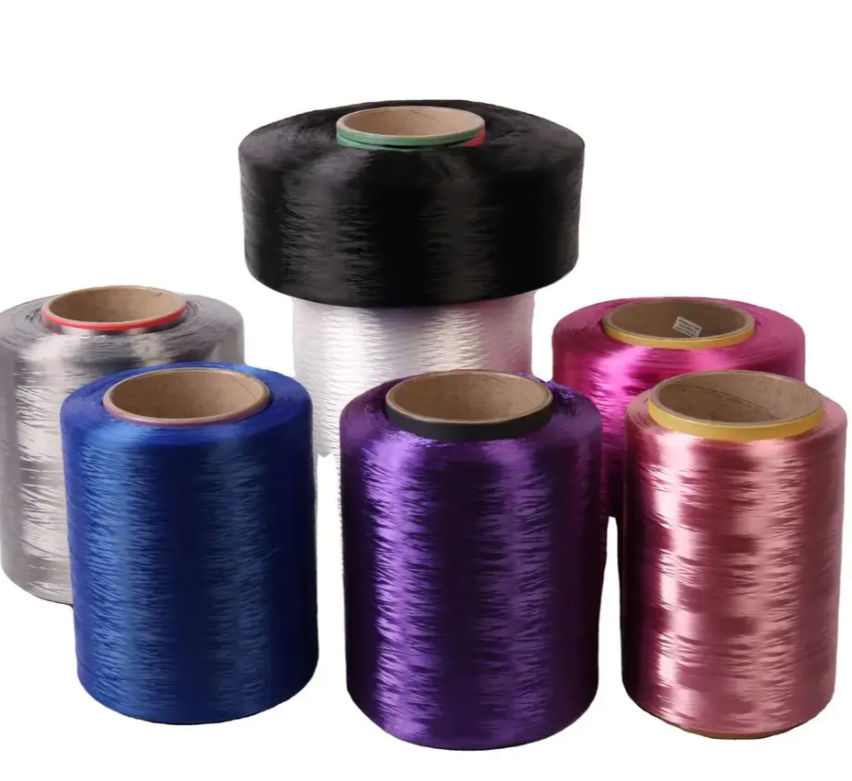
Most polyester filament yarn on the market falls into one of three categories, and the difference comes down to how much drawing and texturing happens after initial spinning.
| Type | Full Name | Key Trait | Typical Use |
|---|---|---|---|
| POY | Partially Oriented Yarn | Under-drawn, intermediate product | Feedstock for texturing into DTY |
| FDY | Fully Drawn Yarn | Fully oriented, smooth, low stretch | Silky woven fabrics, linings |
| DTY | Draw Textured Yarn | Textured, bulky, elastic | Knitwear, activewear, upholstery |
POY is rarely sold as a finished product on its own — it exists mainly as the intermediate stage that gets further drawn into FDY or texturized into DTY, so most buyers are really choosing between the finished FDY and DTY, not POY itself.
Other Types of Polyester Yarn and Their Applications
Beyond the FDY/DTY/POY filament classification, polyester yarn is also grouped by fiber form and performance characteristics, each suited to different fabric goals.
- Staple yarn — spun from short, cut fibers rather than continuous filament, giving fabric a cotton-like hand feel
- Textured yarn — bulked filament yarn with added stretch and volume, common in knitwear
- High tenacity yarn — drawn under higher tension for maximum tensile strength, used where the fabric needs to survive heavy mechanical load
- Air-textured yarn — filaments bulked using compressed air rather than heat, producing a cotton-like, low-luster surface
Choosing between these forms usually comes down to the fabric's end feel — smooth and silky calls for FDY, stretchy and warm calls for DTY, and cotton-like softness calls for staple or air-textured yarn.
Polyester Yarn vs Cotton Yarn: Key Differences
Polyester and cotton yarn behave differently on nearly every performance axis that matters to a textile buyer, and the two are rarely direct substitutes for each other without changing the fabric's character.
- Polyester resists wrinkling and holds shape better; cotton wrinkles more easily but breathes better against the skin
- Polyester dries fast and wicks moisture; cotton absorbs moisture and stays wet longer
- Polyester holds up to abrasion and repeated washing with less fiber breakdown than cotton
- Cotton takes dye more readily and evenly; polyester requires disperse dyes and higher dyeing temperatures
Many performance fabrics blend the two specifically to offset each fiber's weak points — polyester for durability and shape retention, cotton for breathability and softness.
Polyester Yarn Properties and Advantages
Polyester's popularity as a textile fiber comes down to a consistent set of properties that hold up across a wide range of fabric constructions and finishing processes.
- High tensile strength relative to weight, even in fine deniers
- Strong resistance to stretching, shrinking, and wrinkling
- Low moisture absorption, which speeds drying and limits mildew growth
- Good resistance to most chemicals, UV degradation, and abrasion
- Consistent, controllable properties across production batches, since it's a manufactured fiber rather than a natural one
High Tenacity Polyester Yarn Applications
High tenacity polyester yarn is drawn to a much higher orientation than standard textile-grade yarn, which pushes its tensile strength well above what's needed for apparel fabric. That extra strength is the whole point — it's built for load-bearing and industrial uses, not clothing.
- Seatbelts and automotive safety webbing
- Industrial belting, ropes, and tarpaulins
- Tire cord reinforcement
- Fishing nets and marine cordage
- Conveyor belts and heavy-duty canvas
Tenacity is measured in grams per denier (g/d), and high tenacity yarn typically runs well above the 6–7 g/d range of standard textile polyester, which is the figure most technical buyers check first when specifying an industrial-grade yarn.
Polyester Yarn for Sportswear and Activewear
Sportswear fabric has specific demands — stretch recovery, moisture management, and durability under repeated flexing — and polyester yarn, particularly DTY and specialty moisture-wicking variants, is built to meet all three.
Textured DTY yarn gives knit fabrics the stretch and recovery needed for close-fitting activewear, while cross-section engineering (trilobal or multi-channel filament shapes) increases the surface area available to pull moisture away from the skin. Many activewear fabrics also blend polyester with a small percentage of spandex to add mechanical stretch that the polyester alone can't provide.
Recycled polyester yarn has also become common in sportswear lines, since rPET performs nearly identically to virgin polyester in stretch, wicking, and durability testing while meeting sustainability requirements that many sportswear brands now specify at the sourcing stage.
Polyester Yarn Sustainability and Recycling Trends
Recycled polyester (rPET) has moved from a niche sustainability claim to a mainstream sourcing requirement across apparel, home textiles, and technical fabrics, driven largely by brand-level recycled-content targets and tightening regulation on textile waste.
- Mechanical recycling (bottle-to-fiber) remains the dominant route, though it slightly degrades polymer quality with each cycle
- Chemical recycling, which breaks PET back down to base monomers before re-polymerizing, is scaling up and produces fiber closer to virgin quality
- Textile-to-textile recycling (reclaiming fiber from old garments rather than bottles) is still a smaller share of supply but growing as collection infrastructure improves
For buyers specifying recycled content, certification traceability (such as chain-of-custody documentation from the feedstock stage onward) is increasingly what separates a verifiable recycled-content claim from a marketing one.
How to Choose Polyester Yarn for Textile Production
Selecting the right polyester yarn comes down to matching four specifications to the fabric's intended performance, roughly in this order:
- Yarn form — filament (FDY/DTY) for smooth or stretchy synthetic-feel fabrics, staple for a cotton-like hand
- Denier and filament count — finer deniers for lightweight, drapey fabric; heavier deniers for structured or industrial use
- Tenacity requirement — standard textile-grade for apparel, high tenacity for load-bearing or industrial applications
- Virgin vs recycled content — driven by brand sustainability targets, cost, and whether certification traceability is required
Getting the denier and tenacity specification wrong is the most common costly mistake — a yarn that's too fine for the application shows pilling and thinning fast, while over-specifying tenacity adds cost without adding usable performance.