
Content
What Distinguishes Nylon 66 Yarn From Other Polyamides
Nylon 66 yarn is a high-performance synthetic fiber engineered from hexamethylene diamine and adipic acid. Unlike nylon 6, which derives from a single monomer, the double-component structure of nylon 66 yields a tighter polymer chain alignment. This molecular architecture directly translates into a melting point of approximately 255°C, roughly 40°C higher than nylon 6, making it the material of choice for applications exposed to sustained thermal stress.
The practical advantage lies in its tenacity. Standard nylon 66 fully drawn yarn routinely achieves breaking strengths of 8.5 to 9.5 grams per denier. This exceeds most commodity polyester and nylon 6 filaments, allowing fabric manufacturers to reduce denier count without sacrificing tensile integrity. The trade-off is a slightly higher moisture regain of around 4.5%, which must be accounted for in precision coating or lamination processes.
Nylon 66 FDY: Production and Performance Characteristics
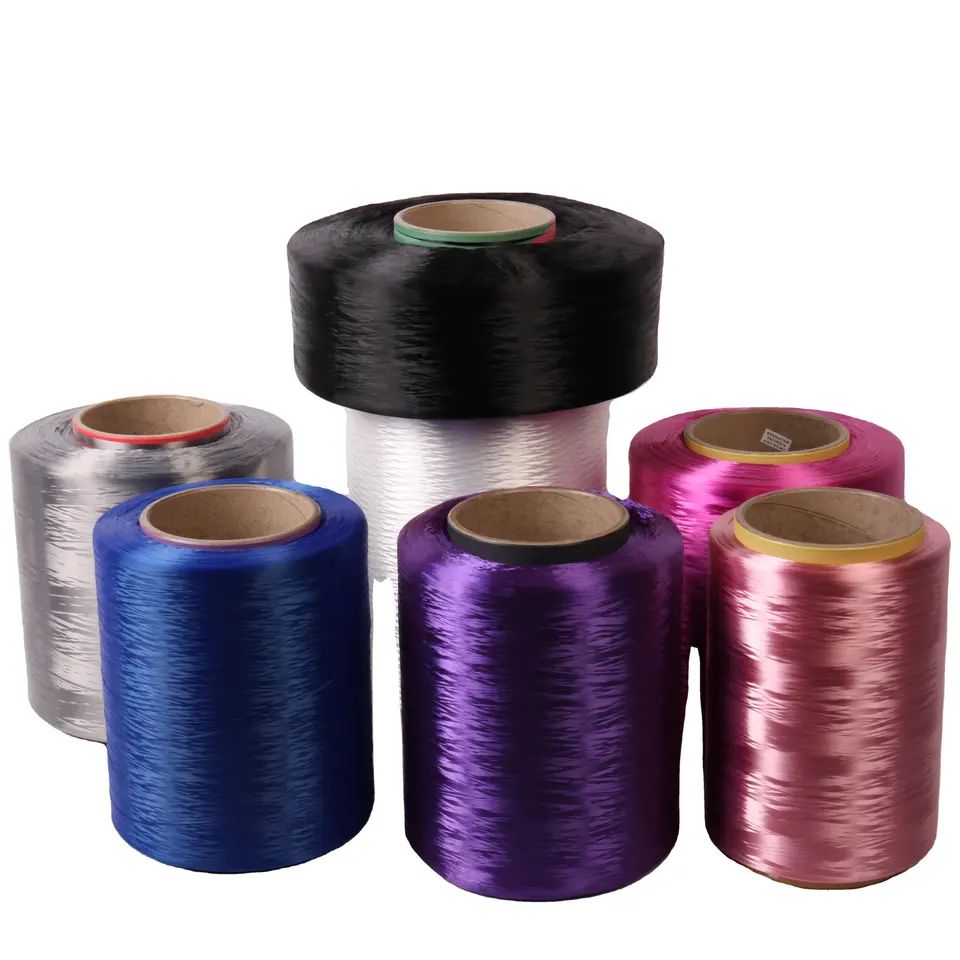
Nylon 66 FDY (Fully Drawn Yarn) is produced through a continuous spin-draw process. The polymer melt is extruded through a spinneret, cooled, and immediately drawn to its final orientation ratio in a single integrated step. This eliminates the separate drawing stage required in conventional spinning, locking in molecular orientation right at the winder. The result is a filament with exceptionally uniform denier, low elongation at break, and minimal shrinkage.
FDY variants are the backbone of high-speed weaving and warp knitting operations. Because the yarn enters the fabric formation stage already fully oriented, it resists necking under tension. Typical elongation values sit between 20% and 28%, providing enough give for the weaving shed without introducing fabric instability. This makes nylon 66 FDY the standard choice for airbag fabrics, where consistent expansion and burst strength are non-negotiable, and for the tightly woven shells of high-denier luggage and outdoor gear.
Nylon 66 DTY: Texturing, Stretch, and Bulk
Nylon 66 DTY (Draw Textured Yarn) follows a different path. Partially oriented yarn (POY) is first spun at a lower speed, retaining significant undrawn molecular segments. This POY is then fed through a texturing machine where it is simultaneously drawn and false-twisted. The application of heat sets the helical crimp geometry into each filament before the twist is mechanically removed, leaving a yarn composed of coiled, elasticized fibers.
The defining property of DTY is its crimp contraction percentage, frequently ranging from 15% to 35% depending on the texturing parameters. This bulk and stretch recovery mechanism transforms a flat, slick filament into a yarn that mimics the hand feel of natural fibers. DTY nylon 66 exhibits crimp stability even after repeated loading, making it indispensable for circular knits in activewear, hosiery, and form-fitting athleisure garments. The higher bulk also improves thermal insulation and moisture transport, key advantages over the more compact FDY structure in next-to-skin applications.
FDY or DTY: Selecting the Correct Nylon 66 Yarn for Your Application
The decision between nylon 66 FDY and DTY is dictated by the mechanical demands of the downstream process and the end-use functional requirements. FDY favors dimensional stability and maximum tensile strength, while DTY prioritizes bulk, stretch recovery, and tactile softness. Evaluating both against specific performance criteria is essential.
| Property | Nylon 66 FDY | Nylon 66 DTY |
|---|---|---|
| Breaking Tenacity (g/d) | 8.5 - 9.5 | 4.5 - 5.5 |
| Elongation at Break (%) | 20 - 28 | 25 - 35 |
| Boiling Water Shrinkage (%) | 6 - 8 | 3 - 5 |
| Crimp Contraction (%) | None (flat filament) | 15 - 35 |
| Typical End-Use | Airbags, woven webbing, luggage shells, automotive fabrics | Activewear, hosiery, seamless garments, upholstery knits |
Beyond the basic FDY/DTY classification, nylon 66 yarn can be further engineered with specialized lusters, cross-sections, and additive packages. Solution-dyed variants embed pigment directly into the polymer melt stream, achieving colorfastness that outlasts piece-dyeing. Trilobal cross-sections enhance soil hiding and wicking. Antimicrobial additives compounded into the resin can be applied to either FDY or DTY, broadening the functional scope of nylon 66 in healthcare and hospitality textiles. The versatility of this polyamide platform continues to expand as spinning and texturing technologies advance.