
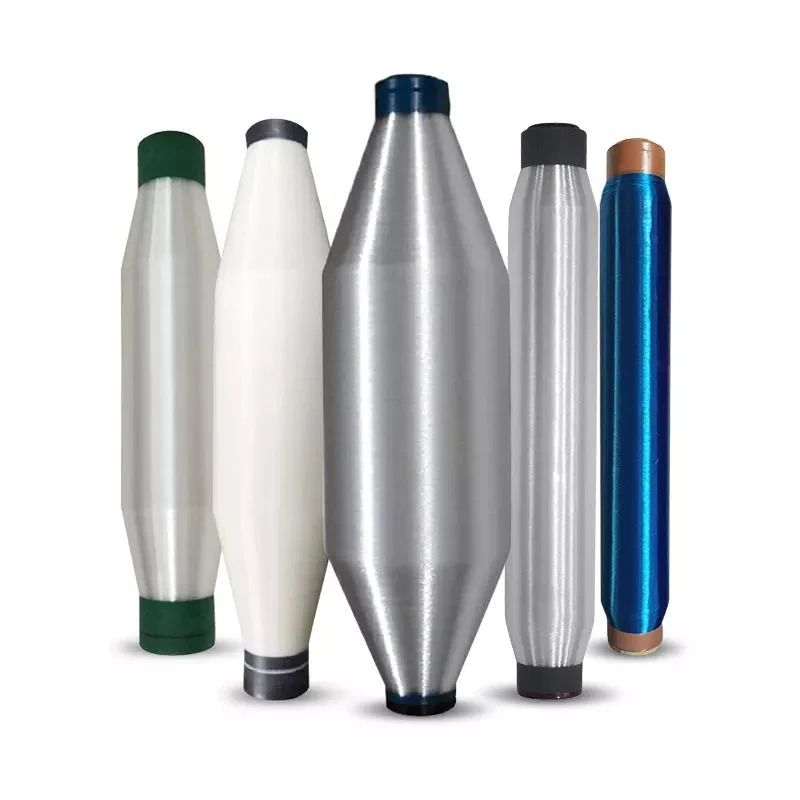
Polyester monofilament yarn is a single continuous strand of extruded polyester — as opposed to multifilament yarn, which bundles many fine fibers together — and this single-strand structure gives it distinct stiffness, abrasion resistance, and dimensional stability that make it suited for technical applications like filter fabrics, screen printing mesh, and industrial brushes rather than soft goods like clothing.
Content
How Monofilament Differs from Multifilament Polyester Yarn
The fundamental difference comes down to cross-sectional structure. Multifilament yarn is composed of dozens to hundreds of individual filaments twisted or bundled together, giving it softness, flexibility, and a textile-like hand feel — ideal for woven and knitted fabrics intended for apparel or soft furnishings. Monofilament yarn, by contrast, is a single solid filament, which behaves more like a fine plastic wire than a textile fiber.
- Monofilament holds its shape under tension and resists deformation, making it dimensionally stable for mesh and screen applications where consistent pore size matters
- Multifilament has a larger total surface area for the same overall thickness, which improves dye uptake and drape but increases moisture and particle retention
- Monofilament's smooth, non-porous surface resists bacterial growth and is easier to clean — a key reason it's used in filter fabrics for food and chemical processing
- Multifilament generally has better flexibility and a softer feel, while monofilament tends to be stiffer and can have a noticeable "memory" that causes it to spring back to its original shape
How Polyester Monofilament Yarn Is Manufactured
Production starts with polyester resin (PET) chips, which are melted and extruded through a spinneret — a metal plate with precisely sized holes that determine the filament's initial diameter. Unlike multifilament spinning, which uses spinnerets with hundreds of small holes, monofilament extrusion uses spinnerets with far fewer, larger holes, since each hole produces one finished filament rather than contributing to a bundled strand.
After extrusion, the filament passes through several critical processing stages:
- Quenching: The molten filament is rapidly cooled, typically in a water bath, to solidify it before further processing.
- Drawing (stretching): The filament is stretched to several times its original length, which aligns the polymer molecular chains along the filament's axis — this step is what gives monofilament its high tensile strength.
- Heat setting: The drawn filament is heated under controlled tension to stabilize its dimensions and reduce shrinkage during later use, particularly important for applications involving heat exposure.
- Winding: The finished filament is wound onto spools or bobbins at a controlled tension to avoid introducing kinks or uneven stress that could cause breakage during weaving or other downstream processes.
The draw ratio — how much the filament is stretched relative to its as-extruded length — directly affects the trade-off between tensile strength and elongation: a higher draw ratio increases strength and stiffness but reduces the filament's ability to stretch before breaking.
Diameter, Denier, and Tensile Strength Specifications
Monofilament yarn is specified by diameter (often in millimeters) or by denier (grams per 9,000 meters of yarn), and the choice between these units often depends on the industry — technical filtration and brush manufacturing tend to specify diameter directly, while broader yarn trading often uses denier.
| Diameter Range | Approximate Denier | Typical Application |
|---|---|---|
| 0.05–0.15mm | ~20–150 | Fine filtration mesh, screen printing mesh |
| 0.15–0.40mm | ~150–1,000 | Industrial filter fabrics, fishing line, sewing thread |
| 0.40mm and above | 1,000+ | Brush bristles, geotextiles, ropes and cords |
Tensile strength is typically reported alongside elongation at break — for standard polyester monofilament, tensile strength commonly falls in the range of 4 to 7 grams per denier (g/d), with higher-tenacity grades used where the yarn will be subject to repeated flexing or high mechanical loads, such as woven filter belts that flex continuously around rollers.
Surface Treatments and Performance Modifications
Raw polyester monofilament can be modified through surface treatments and additives to suit specific operating environments, particularly where chemical exposure, temperature extremes, or anti-static properties matter.
- Heat stabilization: Additional heat-setting treatments improve dimensional stability at elevated operating temperatures, important for filter fabrics used in hot industrial processes
- Anti-static treatment: Conductive coatings or additives reduce static buildup, relevant in screen printing mesh and dry powder filtration where static can cause material clumping or screen damage
- UV stabilizers: Added during extrusion to slow degradation from prolonged sun exposure in outdoor applications such as geotextiles and agricultural netting
- Surface texturing or roughening: Some applications, such as certain brush bristles, benefit from a slightly textured surface to improve grip or cleaning performance compared to the naturally smooth as-extruded finish
When specifying monofilament for a chemical processing or filtration application, it's worth confirming the polyester's resistance to the specific chemicals it will contact — while polyester generally handles dilute acids reasonably well, it has limited resistance to strong alkalis and certain solvents, which can cause gradual degradation and reduced tensile strength over time even if the yarn appears visually unchanged.