
Content
- 1 Polyester Filament: The Complete Industry Guide
- 2 Polyester Filament vs Staple Fiber: Understanding the Fundamental Difference
- 3 How Polyester Filament Is Made
- 4 What Is POY Polyester Yarn
- 5 What Is FDY Polyester Yarn
- 6 What Is DTY Polyester Yarn
- 7 Polyester Filament Properties
- 8 Polyester vs Nylon Filament: Choosing the Right Synthetic
- 9 Polyester Microfilament Guide
- 10 High Tenacity Polyester Filament Applications
- 11 Polyester Filament Uses in the Textile Industry
- 12 Frequently Asked Questions About Polyester Filament Yarn
Polyester Filament: The Complete Industry Guide
Polyester filament yarn is the world's most produced synthetic textile fibre, accounting for over 55% of global synthetic fibre output. Unlike staple fibre — which is cut into short lengths and spun — filament yarn runs as a continuous strand from the spinneret to the final package, giving it fundamentally different performance characteristics and processing requirements. This guide covers everything from raw material to finished product: how filament is made, the key yarn types (POY, FDY, DTY), mechanical properties, a comparison with nylon, microfilament technology, and the full spectrum of end-use applications.
Polyester Filament vs Staple Fiber: Understanding the Fundamental Difference
The distinction between polyester filament and staple fiber begins at the point of manufacture and determines every downstream property the yarn will possess.
Filament yarn is spun as a continuous strand of indefinite length. Multiple individual filaments — each produced by a single hole in the spinneret — are grouped together to form a multifilament yarn. The number of filaments and the denier per filament (dpf) are controlled parameters set during spinning. Because no fibre ends are exposed, filament yarns have a smooth, lustrous surface, low pilling tendency, high tensile strength per unit count, and excellent dimensional stability.
Staple fiber is produced by cutting filament tow into defined short lengths — typically 32–64 mm for cotton-system processing or 64–150 mm for worsted-system blending. These short fibres are then carded, drawn, and spun into yarn using conventional ring, open-end, or air-jet spinning equipment. Staple yarns have a softer, more textured hand feel and blend readily with natural fibres such as cotton or wool. However, the exposed fibre ends create a hairiness that increases pilling and reduces luster compared to equivalent filament constructions.
The practical consequence for end-use selection is clear: where smoothness, strength, and dimensional consistency are priorities — as in technical textiles, tyre cord, geotextiles, and woven outerwear — filament is preferred. Where softness, bulk, and compatibility with natural-fibre blending matter most — as in knitwear, bed linen, and casual apparel — staple fibre is the standard choice.
| Property | Polyester Filament | Polyester Staple Fiber |
|---|---|---|
| Fibre length | Continuous (indefinite) | 32–150 mm (cut) |
| Surface luster | High (semi-dull to bright) | Lower (hairy surface) |
| Tensile strength | Higher | Lower (twist-dependent) |
| Pilling resistance | Excellent | Moderate |
| Hand feel | Smooth, cool | Softer, warmer |
| Natural fibre blending | Limited | Excellent |
| Typical applications | Technical textiles, outerwear, tyre cord | Knitwear, bedding, casual apparel |
How Polyester Filament Is Made
All polyester filament originates from polyethylene terephthalate (PET), produced by the polycondensation of purified terephthalic acid (PTA) and monoethylene glycol (MEG). The resulting polymer chips — or, in integrated plants, molten polymer fed directly from the reactor — are fed into the melt spinning process.
- Melt extrusion: PET chips are dried to a moisture content below 50 ppm (to prevent hydrolytic degradation) and melted in a screw extruder at approximately 280–295°C. The molten polymer is metered through a gear pump at constant pressure.
- Spinning: The melt is forced through a spinneret — a precision-machined plate containing dozens to thousands of fine holes (typically 0.15–0.35 mm diameter). Each hole produces one filament. The number of holes determines the filament count of the yarn; hole geometry controls the cross-sectional shape of each filament (round, trilobal, hollow, etc.).
- Quenching: Filaments exit the spinneret and pass through a cross-flow air quench zone where temperature drops rapidly from molten to solid state, locking in the initial molecular orientation.
- Finish application: A spin finish — a blend of lubricants and antistatic agents — is applied by a finish roller or jet to reduce friction and enable downstream processing.
- Winding / drawing: The as-spun yarn is wound onto packages at controlled speed. The winding speed determines whether the product is a low-orientation POY, a fully drawn FDY, or an intermediate HOY — a critical manufacturing decision that defines all subsequent processing steps.
Additives introduced into the melt — including TiO₂ (for delustering), carbon black (for black-dyed yarn), flame retardants, or cationic dyeable modifiers — allow targeted property customisation without downstream chemical treatment.
What Is POY Polyester Yarn
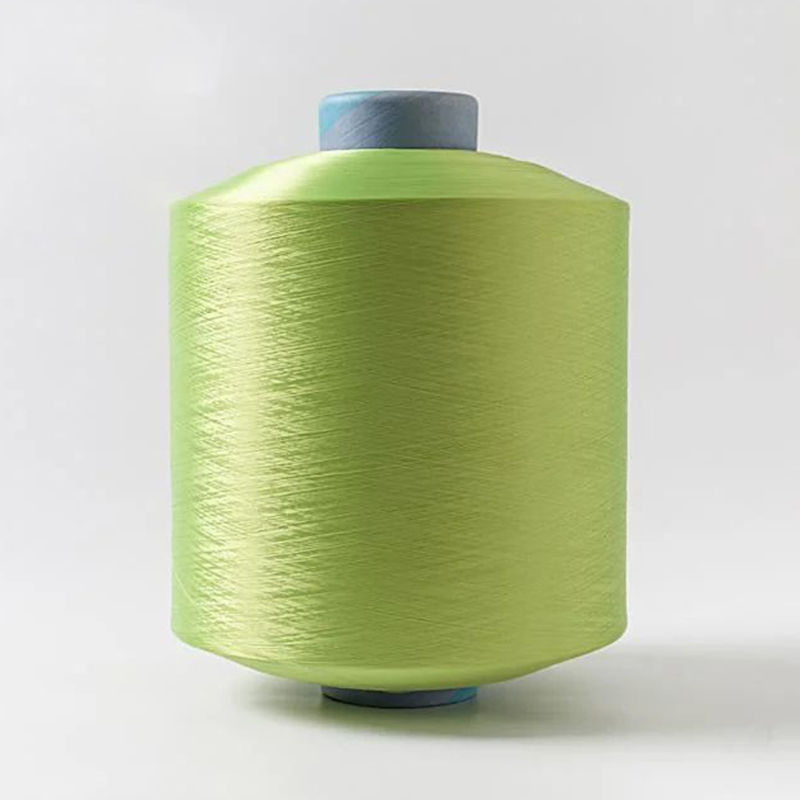
POY (Partially Oriented Yarn) is produced by winding the as-spun filament at 3,000–3,600 m/min — fast enough to generate significant molecular orientation along the fibre axis, but not fast enough to achieve full crystallinity. The result is a yarn with intermediate orientation, moderate tenacity (~2.5–3.0 g/den), and a high residual draw ratio (~1.5–1.7×) that makes it ideal for further processing.
POY is the primary feedstock for draw texturing — the process used to produce DTY. Its incomplete orientation creates the latent drawability that false-twist texturing machines exploit to simultaneously draw, twist, and set the yarn into a crimped, bulky structure. POY is rarely used in its as-wound form in finished fabrics; its role is as an intermediate product within the polyester yarn value chain.
Global POY production is highly concentrated in China, which accounts for over 70% of world output. Standard counts range from 75 to 300 denier, with filament counts of 36, 72, 96, and 144 filaments per yarn being the most commercially common.
What Is FDY Polyester Yarn
FDY (Fully Drawn Yarn), also called spin-draw yarn (SDY), is produced in a single integrated spin-draw process at winding speeds of 4,500–6,000 m/min, with a heated draw zone between the feed and delivery godets that stretches and crystallises the filaments in-line. The result is a yarn with high molecular orientation and crystallinity, delivering:
- Tenacity of 3.5–5.0 g/den (standard FDY) to over 7.5 g/den (high-tenacity variants)
- Elongation at break of 20–35%
- Excellent dimensional stability under heat and tension
- Very low boil-off shrinkage (<1% in standard grades)
FDY is used directly — without further drawing — in weaving, warp knitting, and weft insertion on high-speed looms. Its smooth, uniform structure delivers excellent weavability and produces fabrics with a characteristic clean, lustrous surface. FDY is available in bright, semi-dull, and full-dull (high TiO₂ content) luster variants and in a wide range of cross-sections including trilobal, hollow, and cationic-dyeable modifications.
What Is DTY Polyester Yarn
DTY (Draw Textured Yarn) is produced by feeding POY through a false-twist texturing machine, where the yarn is simultaneously drawn (typically 1.5–1.7×), twisted by a friction disc assembly, passed over a heater set to 150–220°C, untwisted, and optionally set in a second heater zone. The combined action of draw, twist, heat, and untwist imparts a permanent three-dimensional crimp to each filament, transforming the flat POY into a voluminous, elastic yarn.
DTY properties that distinguish it from POY and FDY include:
- Bulk and cover: The crimped structure increases apparent volume by 30–50% over equivalent FDY counts, providing superior cover in fabrics.
- Stretch and recovery: DTY fabrics exhibit good elastic recovery without the addition of spandex, particularly in interlock and jersey knit constructions.
- Soft hand: The crimped filaments break up the flat, smooth surface of FDY, yielding a softer, warmer feel closer to natural fibre.
- Twist variants: DTY is produced in S-twist, Z-twist, and intermingled (air-entangled) forms. Intermingled DTY replaces twist with periodic entanglement points, improving cohesion without the torque liveliness associated with twist.
DTY is the dominant yarn type in circular knitted fabrics for sportswear, leisurewear, and activewear, as well as in warp-knitted tricot and velvet structures. Global DTY output exceeds 12 million tonnes per year, making it the single largest category of textured synthetic yarn.
Polyester Filament Properties
Polyester filament yarn offers a combination of mechanical, chemical, and physical properties that no single natural fibre matches across all dimensions:
- Tensile strength: Standard FDY delivers 3.5–5.0 g/den; high-tenacity (HT) grades reach 7.5–9.5 g/den — sufficient for tyre cord and industrial webbing.
- Moisture absorption: PET is inherently hydrophobic, with a moisture regain of just 0.4% at standard conditions (vs. 8.5% for cotton and 16% for wool). This translates to fast drying and excellent retention of mechanical properties when wet.
- Thermal stability: Melting point of 255–260°C; glass transition temperature approximately 70°C. Fabrics can be heat-set to achieve permanent dimensional stability and crease resistance.
- Chemical resistance: Resistant to most dilute acids, bases, and common organic solvents; susceptible to concentrated alkalis (used intentionally in alkali weight-reduction finishing to create a silk-like hand).
- UV resistance: Good inherent UV stability, further improved by UV-stabilising additives; suitable for outdoor technical applications without special treatment.
- Dyeability: Standard PET requires disperse dyes applied at high temperature (130°C under pressure) or with carriers. Cationic-dyeable PET (CDP) accepts basic dyes at atmospheric pressure, enabling bright colours and two-tone dyeing effects in blended fabrics.
- Elasticity: Elastic recovery of approximately 95% from 5% elongation — superior to cotton and comparable to wool, contributing to the wrinkle resistance that makes polyester a dominant shirting material.
Polyester vs Nylon Filament: Choosing the Right Synthetic
Polyester and nylon (polyamide) are the two dominant synthetic filament fibres, and the choice between them is a recurring decision in technical and apparel textile development. They are not interchangeable — each excels in a distinct set of conditions.
| Property | Polyester Filament | Nylon Filament |
|---|---|---|
| Tensile strength (dry) | 3.5–9.5 g/den | 4.5–9.0 g/den |
| Strength retention when wet | ~100% | ~85–90% |
| Moisture regain | 0.4% | 4.0–4.5% (Nylon 6.6) |
| Abrasion resistance | Good | Excellent (superior) |
| UV resistance | Good | Poor (yellows, degrades) |
| Melting point | 255–260°C | 215°C (Nylon 6) / 255°C (Nylon 6.6) |
| Density | 1.38 g/cm³ | 1.14 g/cm³ |
| Raw material cost | Lower | Higher (~2–3×) |
| Dyeability | Disperse dyes (130°C) | Acid dyes (atmospheric) |
The practical decision rules are well-established in the industry: choose nylon where abrasion resistance is the overriding concern — hosiery, swimwear, parachute fabric, heavy-duty pack cloth, and shoe uppers all leverage nylon's superior surface durability. Choose polyester where UV exposure, dimensional stability, cost efficiency, or dry-wicking performance are the primary requirements — outdoor furnishings, tarpaulins, seatbelt webbing, filtration fabric, and the majority of woven apparel applications favour polyester on these grounds.
Polyester Microfilament Guide
A polyester microfilament is defined as a filament with a linear density of 1.0 denier per filament (dpf) or less — approximately one-third the diameter of a human hair and finer than the finest natural silk filament. Achieving this requires precision spinneret engineering, careful melt rheology control, and significantly higher draw ratios than standard filament production.
The performance advantages of microfilament construction arise directly from the increased number of filaments per yarn cross-section and the correspondingly larger surface area:
- Softness: Bending stiffness of a filament scales with the fourth power of its radius — halving the filament diameter reduces stiffness by a factor of 16. A 75D/144f microfilament yarn (0.52 dpf) is dramatically softer than a 75D/36f standard yarn despite identical linear density.
- Wicking performance: The dense capillary network between microfilaments moves moisture by capillary action far more efficiently than coarser structures, making microfilament fabrics the preferred choice in high-performance moisture-management sportswear.
- Wind and water resistance: When woven at high cover factors, microfilament fabrics achieve pore sizes small enough to resist wind penetration without a membrane — the basis of the "peach skin" and "ultra-microfibre" woven constructions widely used in outerwear shells.
- Cleaning cloth applications: Sub-denier microfilament nonwovens and woven cloths trap particles mechanically within the inter-filament spaces, delivering cleaning performance unachievable with conventional textile structures.
Ultra-microfilament yarns below 0.3 dpf — sometimes called "sea-island" or "segmented-pie" bicomponent fibres — require a two-component spinning process where one polymer (the "sea") is dissolved or split away after weaving, releasing the ultra-fine "island" filaments in situ. This technology enables filament fineness down to 0.001 dpf, approaching the diameter of natural nanofibers.
High Tenacity Polyester Filament Applications
High tenacity (HT) polyester filament — produced by applying higher draw ratios and optimised heat-setting conditions to achieve tenacities of 7.5–9.5 g/den — serves a fundamentally different set of markets than standard textile filament. These applications demand the yarn's structural integrity under sustained mechanical stress rather than its aesthetic or comfort properties.
- Tyre cord fabric: Polyester HT filament is the dominant reinforcement material in passenger car radial tyre body plies, offering excellent adhesion to rubber compounds, low creep under inflation pressure, and resistance to thermal fatigue. Annual consumption exceeds 800,000 tonnes globally in this application alone.
- Seatbelt webbing: The load-bearing strap of a motor vehicle seatbelt must absorb several kilonewtons of crash energy without failure. HT polyester — woven into 48mm webbing at defined breaking strengths above 15 kN — has been the standard material in automotive restraint systems since the 1980s.
- Industrial ropes and straps: Lifting slings, lashing straps, cargo nets, and mooring lines constructed from HT polyester filament offer strength-to-weight ratios superior to wire rope in many applications, combined with resistance to UV, moisture, and chemical environments.
- Geotextiles: Woven and nonwoven geotextile fabrics for road subbase reinforcement, retaining wall stabilisation, and erosion control rely on HT polyester for tensile strength retention over design lives of 50–100 years in soil environments.
- Airbag fabric: The base fabric of automotive airbag cushions uses coated or uncoated HT polyester or nylon filament woven to precise porosity specifications that govern bag deployment rate and pressure retention.
- Filtration: Industrial filter bags and press cloth for cement, power generation, and chemical processing use HT polyester for its combination of strength, temperature resistance (up to ~150°C continuous), and chemical stability.
Polyester Filament Uses in the Textile Industry
The breadth of polyester filament uses in the textile industry reflects the yarn's versatility across count ranges, surface treatments, and construction types. Major application categories include:
Apparel Fabrics
FDY-based woven fabrics — including taffetas, satins, chiffons, and twills — dominate the mid-to-premium segment of the global womenswear, workwear, and lining markets. DTY-based circular and warp knits account for the majority of activewear, sportswear, swimwear, and casual knit fabrics. The shift toward polyester in apparel has been consistent across two decades: polyester surpassed cotton as the world's largest apparel fibre by volume in 2002 and has widened its lead every year since.
Home Textiles
Curtain and drapery fabrics, upholstery, and decorative textiles rely heavily on polyester FDY and textured filament for dimensional stability, UV resistance, and colourfastness. Polyester microsuede — a nonwoven or woven microfilament substrate with a brushed surface — has largely displaced genuine suede in furniture upholstery due to its superior cleanability and abrasion resistance.
Technical and Industrial Textiles
Beyond the HT applications already described, standard-tenacity polyester filament is used extensively in coated technical fabrics (tarpaulins, awnings, truck curtains), medical textiles (implantable mesh, surgical suture), and agrotextiles (shade netting, crop protection fabric). The combination of low cost, processing versatility, and reliable performance makes polyester the default substrate whenever synthetic fibre performance is required without a specific reason to choose an alternative.
Recycled Polyester Filament
Recycled PET (rPET) filament — produced by mechanically or chemically recycling post-consumer PET bottles or post-industrial fibre waste — has grown from a niche specification to a mainstream commercial product. Leading sportswear brands now specify rPET content in excess of 50% of polyester volume in their supply chains, driving significant capacity expansion in bottle-to-fibre recycling globally. Mechanical rPET filament is price-competitive with virgin FDY in standard counts; chemical recycling technology is bringing performance parity in high-specification grades.
Frequently Asked Questions About Polyester Filament Yarn
- What is the difference between POY, FDY, and DTY polyester yarn?
POY (Partially Oriented Yarn) is a semi-finished intermediate with high residual drawability, used primarily as feedstock for DTY texturing. FDY (Fully Drawn Yarn) is a finished yarn with full orientation and crystallinity, used directly in weaving and warp knitting. DTY (Draw Textured Yarn) is produced from POY by simultaneous drawing and false-twist texturing to create a crimped, bulky, stretch-capable yarn used in knit fabrics and many woven apparel applications.
- Is polyester filament stronger than nylon filament?
In dry conditions, high-tenacity grades of both fibres are broadly comparable. However, polyester retains nearly 100% of its dry strength when wet, whereas nylon loses 10–15%. Nylon has significantly better abrasion resistance than polyester, making it the stronger choice in applications involving surface wear. Polyester has better UV resistance and costs substantially less.
- What denier is considered a microfilament?
A microfilament is generally defined as having a linear density of 1.0 denier per filament (dpf) or less. Ultra-microfilaments fall below 0.3 dpf and typically require bicomponent spinning techniques. The softness, drape, and wicking performance of microfilament fabrics increase significantly as dpf decreases below 1.0.
- What are the main applications of high tenacity polyester filament?
High tenacity polyester filament (7.5–9.5 g/den) is used primarily in tyre cord fabric, automotive seatbelt webbing, industrial lifting slings and lashing straps, geotextile reinforcement, airbag cushion fabric, and industrial filtration. These applications require sustained load-bearing performance rather than aesthetic or comfort properties.
- Can polyester filament yarn be made from recycled materials?
Yes. Recycled PET (rPET) filament is commercially well-established, with the primary feedstock being post-consumer PET bottles. Mechanical recycling produces chips that are re-melted and spun into filament; chemical recycling breaks PET back to its monomers before re-polymerisation, enabling higher purity and better retention of physical properties compared to mechanical routes. rPET filament is now widely specified in sportswear, outdoor apparel, and home textile supply chains.